Choosing the Right Base Nutrient System for Your Growing Method
Learn how to select the right base nutrient system for soil, hydroponic, and soilless growing. Expert guide to building effective feeding programs.

Most growers choose base nutrients based on brand recognition or price. Then they wonder why their plants show deficiencies despite regular feeding. The problem isn't the nutrients - it's the mismatch between nutrient formulation and growing method.
Base nutrients aren't universal. What works in soil fails in hydroponics. What delivers results in coco coir creates problems in traditional potting mix. BioFloral has curated over 2,000 products from 100 trusted brands over 25 years of serving Canadian growers, and one pattern stands out: successful growers match their base nutrients to their growing method, not the other way around.
What Base Nutrients Actually Do (And Why They Matter)
Base nutrients provide the foundational nutrition plants need throughout their lifecycle. Unlike supplements and additives that target specific growth stages or functions, base nutrients deliver the primary macronutrients - nitrogen (N), phosphorus (P), and potassium (K) - plus essential secondary nutrients and micronutrients.
Think of base nutrients as the complete meal, while additives are the dessert or supplements. You can skip dessert and survive, but you can't skip the main meal. This is why choosing the right base nutrient system matters more than any other feeding decision you'll make.
The formulation of base nutrients varies with the growing medium. Soil contains natural minerals and organic matter that release nutrients over time. Hydroponic systems contain zero nutrients - everything must come from your feeding program. Soilless media like coco coir fall somewhere in between. Each situation demands different nutrient formulations.
Dr. Lynette Morgan, a leading horticultural researcher and author of "Hydroponics: Questions & Answers," explains that "the most common mistake growers make is using soil-formulated nutrients in hydroponic systems or vice versa. The pH buffers, chelation methods, and nutrient ratios differ significantly between formulations designed for different growing methods."
Matching Base Nutrients to Your Growing Medium
1. Soil-Based Growing
Soil already contains nutrients, minerals, and beneficial microorganisms. Base nutrients in soil don't need to provide everything; they supplement what the soil naturally provides. Soil-formulated base nutrients typically contain:
Lower overall nutrient concentrations
Organic components that feed soil microbes
pH buffers suited to the soil's natural range (6.0-7.0)
Slower-release forms of certain nutrients
Using hydroponic nutrients in soil often causes problems. Higher concentrations and different pH ranges can overwhelm soil biology and lead to toxic buildup. Soil needs gentler feeding that works with its natural nutrient cycling.
2. Hydroponic Systems
Hydroponic base nutrients must provide complete nutrition because the growing medium offers nothing. Water-based systems demand nutrients that:
Dissolve completely without residue
Remain stable in solution
Include all macro and micronutrients in plant-available forms
Work within the hydroponic pH range (5.5-6.5)
Won't clog irrigation lines or emitters
Hydroponic formulations use mineral salts and chelated micronutrients designed for immediate plant uptake. The nutrients stay in solution and remain available until plants absorb them or you change the reservoir.
3. Coco Coir and Soilless Media
Coco coir presents unique challenges. It's inert, like hydroponics, but provides a physical structure, like soil. Coco naturally holds calcium and magnesium while releasing potassium, which means base nutrients for coco must:
Include extra calcium and magnesium
Account for Coco's natural potassium release
Work in Coco's preferred pH range (5.8-6.3)
Prevent cation exchange issues specific to the coco fiber
Using standard hydroponic nutrients in coco often causes calcium and magnesium deficiencies. Coco-specific formulations prevent these problems by adjusting the base nutrient ratios.
How Growing Scale Affects Base Nutrient Choice
1. Small-Scale Home Growing (1-20 Plants)
Home growers benefit from premixed liquid nutrients that eliminate the need to measure multiple components. The convenience justifies the higher per-unit cost when you're mixing small batches. Liquid nutrients also reduce the risk of measurement errors that plague beginners when mixing powders accurately.
Look for base nutrient systems with clear feeding charts and customer support. When you're starting out, being able to call with questions matters more than saving a few dollars on cheaper alternatives.
2. Mid-Scale Operations (20-100 Plants)
At this scale, efficiency starts mattering. Two-part liquid systems offer the best balance - they're simple enough to use daily but concentrated enough that you're not hauling gallons of water in bottle form. Many growers at this level mix their own stock solutions from dry nutrients to reduce costs.
Consider the space nutrients take up. Concentrated formulas require less storage space and are easier to handle. Calculate the cost per gallon of the mixed solution rather than the cost per bottle to compare options accurately.
3. Commercial Growing (100+ Plants)
Commercial operations almost always use dry nutrients mixed into stock solutions. The cost savings become significant at scale, and automated dosing systems simplify mixing. Professional growers purchase base nutrients in bags or barrels rather than bottles.
At a commercial scale, consistency matters more than brand loyalty. Choose base nutrient systems from manufacturers with consistent quality control and reliable supply chains. Running out mid-cycle or dealing with batch-to-batch variations costs more than any initial savings on cheaper alternatives.
Understanding Nutrient System Types
Base nutrients are available in different formats, each with advantages for specific use cases.
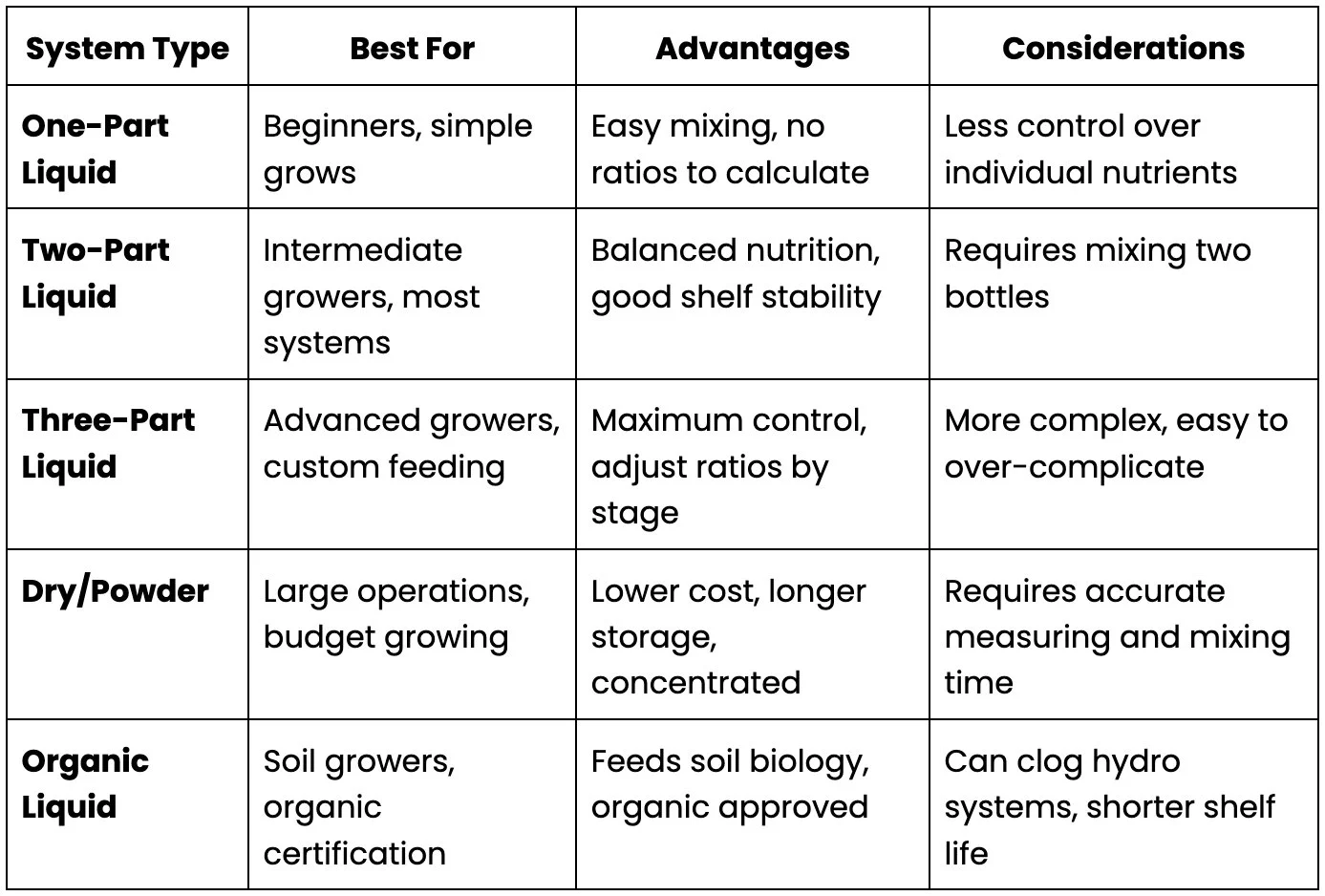
One-part systems simplify feeding but limit adjustment options. Three-part systems offer maximum control but tempt growers to overthink feeding schedules. Two-part systems balance simplicity and flexibility, which is why they dominate professional growing operations.
pH and Base Nutrient Selection
Different growing methods require different pH ranges, and base nutrients include buffers optimized for those ranges. Soil nutrients buffer toward 6.5-7.0, while hydroponic nutrients buffer toward 5.8-6.2. Using the wrong formulation means constantly fighting pH.
Some base nutrient systems include pH stabilizers that reduce pH drift. These work well in smaller reservoirs where pH tends to swing more dramatically. Larger systems with more stable pH might not need this feature, saving you money on unnecessary additives.
Building Your Feeding Schedule
Base nutrients provide the foundation, but application matters as much as selection. Start with the manufacturer's recommendations, then adjust based on the plant's response. Most feeding schedules follow this pattern:
Seedling Stage: Quarter-strength base nutrients or specialized seedling formula
Vegetative Growth: Half to full-strength base nutrients with higher nitrogen ratios
Early Flowering: Full-strength base nutrients transitioning to bloom formulas
Peak Flowering: Bloom-specific base nutrients or adjusted ratios favoring phosphorus and potassium
Late Flowering/Flushing: Reduced or no base nutrients, depending on growing method
The biggest mistake? Overfeeding. Plants can recover more easily from slight underfeeding than from nutrient burn. Start at 75% of recommended strength and increase if plants show hunger signs.
Storage and Shelf Life
Liquid base nutrients last 2-5 years when stored properly. Keep them sealed, away from temperature extremes and direct sunlight. Freezing damages liquid nutrients - if they've frozen, replace them. Dry nutrients last even longer when kept dry and sealed.
Check for precipitation in liquid nutrients before use. Shake bottles thoroughly and inspect for settled solids. Some settling is normal, but nutrients that won't re-suspend have degraded and should be replaced.
FAQs: Base Nutrient Questions Answered
Q: Can I use the same base nutrients for all growth stages?
Some one-part base nutrients work throughout the entire lifecycle, while most professional systems use different formulations for vegetative and flowering stages.
Q: What's the difference between base nutrients and supplements?
Base nutrients provide the essential nutrients plants need to survive and grow. They include all essential macro and micronutrients in balanced ratios. Supplements and additives target specific functions - root development, flowering enhancement, and stress protection.
Q: How do I know if my base nutrients match my water quality?
Measure your source water's PPM and hardness. Most municipalities provide water quality reports online. Water above 200 PPM typically contains sufficient calcium and magnesium that you do not need hard-water-based nutrients.
Q: Should I buy concentrated or ready-to-use base nutrients?
This depends on your growing scale and storage space. Concentrated base nutrients cost less per gallon of mixed solution and take up less storage space. Ready-to-use formulas eliminate measuring errors and save time.
Stay up to date with our latest ideas!