Concrete Driveways vs Asphalt vs Gravel: Why Concrete Wins
Compare concrete, asphalt, and gravel driveways to see why concrete stands out for durability, maintenance, appearance, and long-term value.
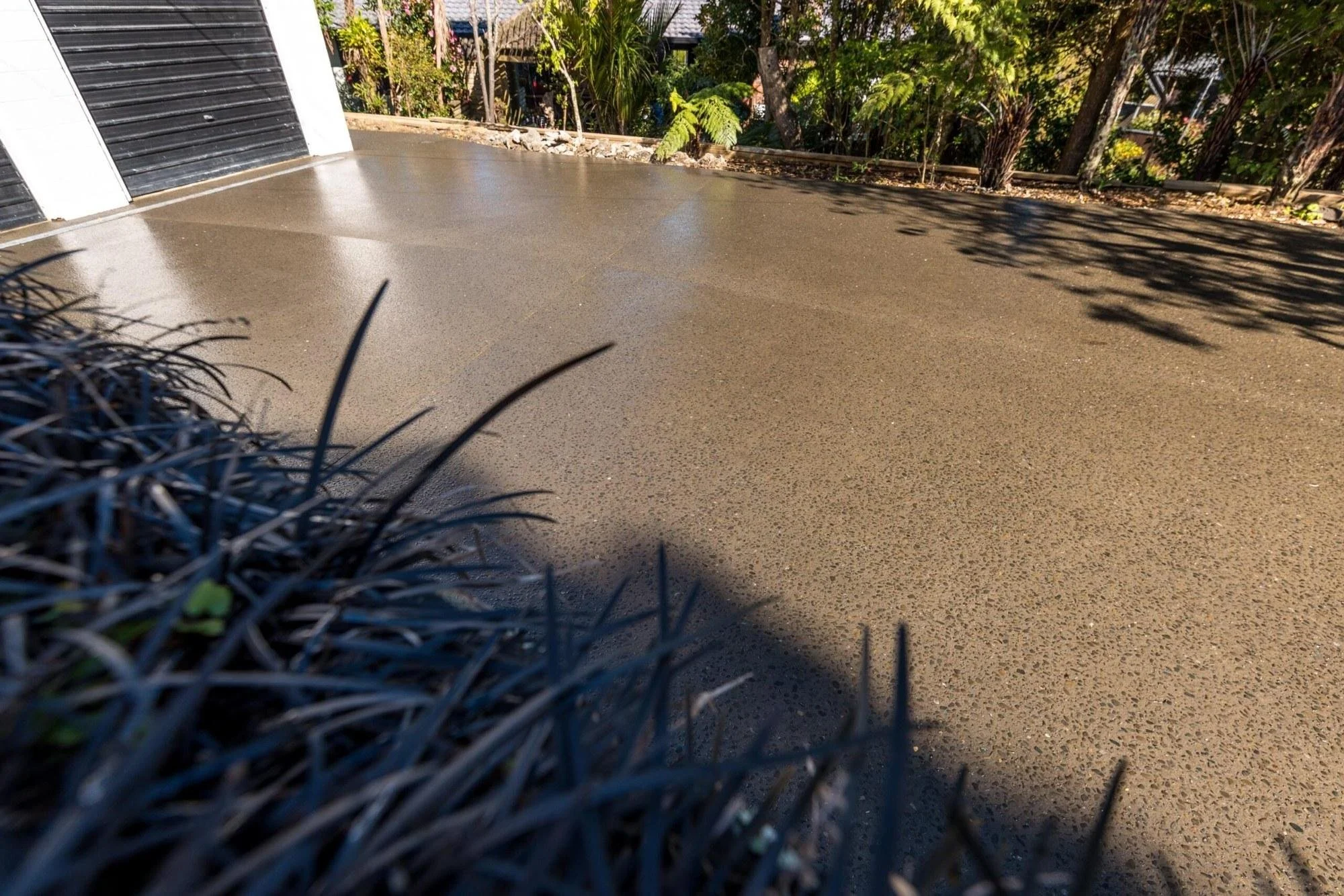
A well-installed concrete driveway in Auckland typically lasts 30 to 50 years with minimal maintenance, compared to 15 to 20 years for asphalt and 5 to 10 years for compacted gravel.
Asphalt requires resealing every 3 to 5 years and is vulnerable to softening during periods of sustained heat above 28°C, which Auckland is recording more frequently.
Concrete driveways reflect more light and absorb less heat than asphalt, a functional advantage for Auckland properties where surface temperature management is becoming a design consideration.
The Real Cost Comparison Over Time
The upfront cost of a concrete driveway in Auckland typically runs between $150 and $250 per square metre for a standard residential pour, depending on thickness, finish, and site preparation required. Asphalt comes in cheaper at roughly $60 to $100 per square metre installed. Gravel is cheaper again — often $20 to $40 per square metre for supply and spread.
Those headline numbers mislead most homeowners. When you account for the full lifecycle, the picture shifts significantly. Asphalt needs resealing every 3 to 5 years at a cost of $15 to $30 per square metre per application. Over a 30-year period, a 60-square-metre asphalt driveway carries cumulative maintenance costs that can exceed its original installation price. Gravel driveways require periodic top-ups, weed control, and edge containment work — costs that are irregular but persistent. Concrete, by contrast, demands little beyond occasional cleaning and crack monitoring.
For example: a 60-square-metre driveway in West Auckland laid in asphalt at $80 per square metre costs $4,800 upfront. Add six resealing cycles over 30 years at an average of $1,200 per application and one full resurfacing at roughly $5,000, and the total cost approaches $17,000. The same driveway in concrete at $200 per square metre costs $12,000 upfront — and likely requires nothing beyond a pressure wash and an occasional joint inspection over that same period. (Figures are indicative 2026 Auckland residential rates and will vary by site and supplier — confirm current pricing before quoting.)
Why Asphalt Underperforms in Auckland’s Climate
Asphalt is a bituminous material — a mixture of aggregates bound together with bitumen, a petroleum-derived binder. Bitumen softens at elevated temperatures. Auckland’s summers, while rarely extreme by international standards, have been recording more frequent sustained periods above 28°C. NIWA data indicates a measurable upward trend in mean summer temperatures across the Auckland region over the past two decades.
Softened asphalt deforms under concentrated load. A vehicle parked in the same spot on a hot January afternoon can leave permanent impressions in an asphalt surface within a few years of installation. This is not a theoretical concern — it is a commonly raised complaint among Auckland homeowners who chose asphalt for its lower initial price point. The problem compounds over time as water infiltrates the deformed surface, the sub-base erodes, and the asphalt begins to crack and break apart from below.
Concrete does not behave this way. A properly designed concrete slab — typically 100mm thick for residential driveways, reinforced with SL72 mesh or equivalent, with correctly spaced control joints at no more than 3 to 4 metre intervals — maintains its structural integrity across Auckland’s full temperature range. It neither softens in heat nor becomes brittle in a way that creates rapid failure.
Note: Concrete can crack if sub-base preparation is inadequate or if control joints are omitted or poorly placed. The material’s durability advantage is contingent on correct installation practice — not the material alone.
The Gravel Question: Cheap Entry, Costly Exit
Gravel driveways occupy a specific niche — they suit large rural properties where vehicles move slowly, drainage is not constrained, and aesthetic uniformity is not a priority. In suburban Auckland, gravel performs poorly on multiple fronts.
First, gravel migrates. Traffic and foot movement progressively scatter loose aggregate onto lawns, garden beds, and footpaths. Auckland’s rainfall — averaging around 1,200mm annually — accelerates this process by washing fines away from the surface and creating rutting. Second, gravel is difficult to keep clean and presents problems for stormwater management on smaller urban sections where runoff needs to be controlled. Third, and most practically: gravel adds no measurable value to a residential property in Auckland’s market, whereas a well-finished concrete driveway is routinely cited by real estate agents as a visible value marker.
Some homeowners return to this comparison every few years, add gravel, and find themselves in the same position: uneven surface, maintenance fatigue, and eventually a decision to concrete the driveway anyway. This pattern is common enough that experienced concrete contractors in Auckland treat gravel-to-concrete conversions as a standard job category. The cost of the initial gravel work, the repeated top-ups, and then the concrete installation together typically exceed what a concrete driveway would have cost at the outset.
Surface Finish Options and Property Aesthetics
Concrete offers a range of finish options that neither asphalt nor gravel can match. Standard finishes include:
Broom finish — textured, slip-resistant, cost-effective, and widely used on residential driveways
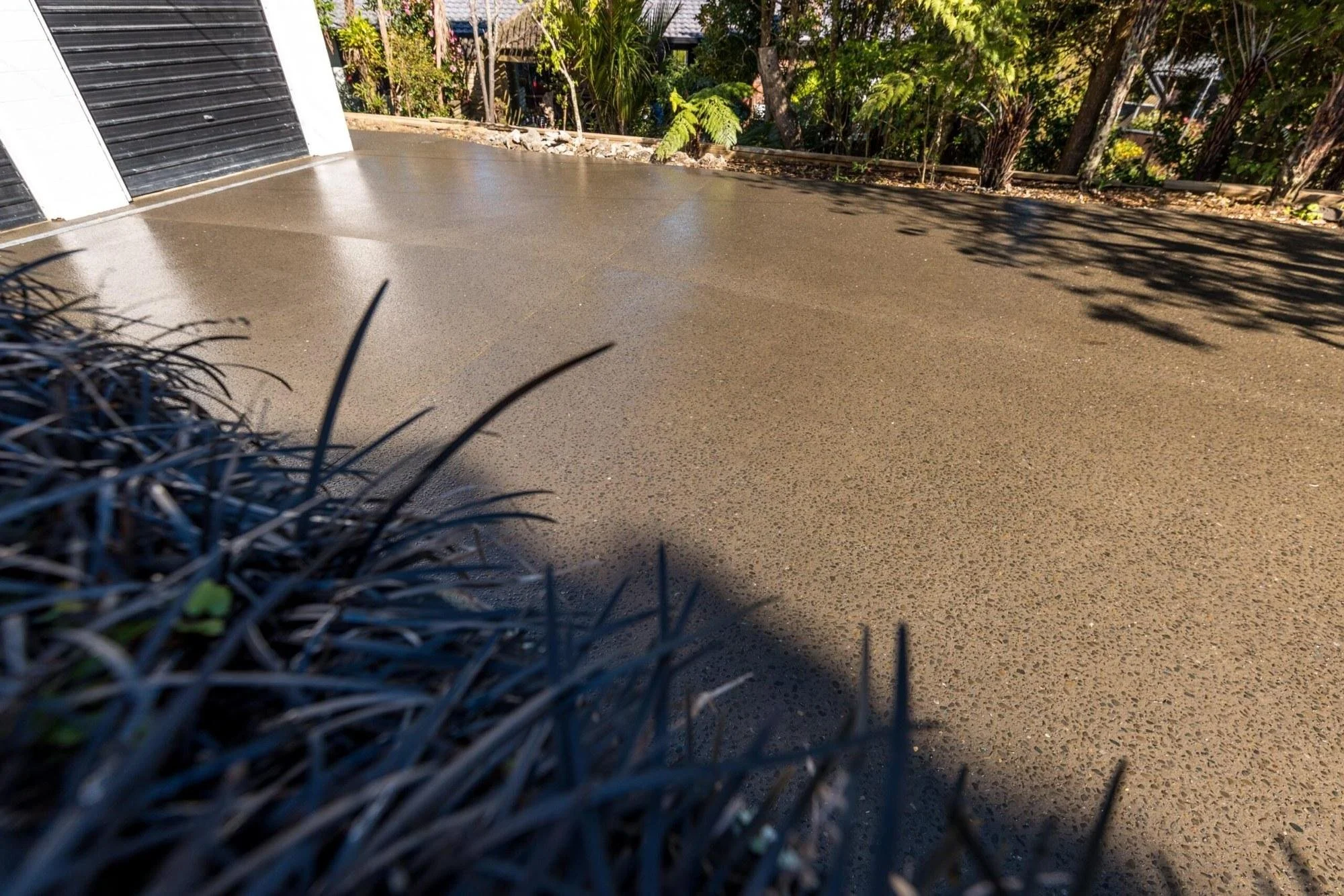
Exposed aggregate — a premium finish that reveals the natural stone in the concrete mix, popular in Auckland’s mid-to-high-end residential market
Pattern or stamped concrete — pressed with moulds to simulate stone, slate, or brick paving at a lower cost than the real material
Honed and polished concrete — ground smooth post-cure, suited to architecturally designed properties where the driveway transitions to interior spaces
Coloured concrete — integral pigments or surface-applied stains that allow the driveway to complement the home’s exterior palette
Asphalt is black. Its appearance can be improved marginally with coloured sealers, but the range is narrow and the effect fades. Gravel offers texture and a natural look that suits specific architectural styles — loose gravel, resin-bound gravel, and decomposed granite each have their advocates — but it remains a niche choice for urban Auckland.
The aesthetic flexibility of concrete matters in Auckland’s competitive residential property market, where exterior presentation influences both buyer perception and sale price. A driveway represents a significant portion of a property’s street-visible hard landscaping. Choosing a surface that degrades visually within ten years works against that investment.
The Honest Downside: Upfront Cost
Cost is the real objection to concrete. If you’re a first-home buyer finishing a new build on a tight budget, the $3,000 to $5,000 premium over asphalt on a standard driveway is a genuine constraint — not a bad decision, just a real one.
Anecdotally, plenty of Auckland developers specified asphalt on 1990s subdivisions to save money, and a lot of those driveways were cracking or worn out within 10 to 15 years, leaving the resurfacing bill to whoever bought the house after. Industry observation (not a formal survey) suggests something similar happened on some subdivisions built during the 2015–2022 boom, for the same reason.
Put simply: install concrete today and you probably won’t be redoing this driveway in 15 years. Install asphalt and there’s a decent chance you will.
Weigh up upfront cost, lifecycle performance and property value together, and concrete is the harder choice to argue against for an Auckland driveway.
Before You Decide
Calculate the total lifecycle cost across 30 years for each surface type before making a decision based on upfront price alone — include resealing, top-ups, and likely replacement cycles.
For a residential driveway in Auckland, specify a minimum 100mm slab thickness, SL72 mesh reinforcement, and control joints at no more than 3 to 4 metre spacing to ensure structural performance.
Request samples or site visits to properties with each finish type before committing — exposed aggregate and broom finish perform very differently underfoot and look significantly different at scale.
If budget is genuinely constrained, consider a concrete driveway in two stages — pour the structural slab now and apply the decorative finish (exposed aggregate, pattern, or stain) at a later date when funds allow.
Get quotes that itemise sub-base preparation separately — this is where corners are most often cut on driveways in Auckland, and inadequate sub-base work is the primary cause of premature concrete failure.
Stay up to date with our latest ideas!